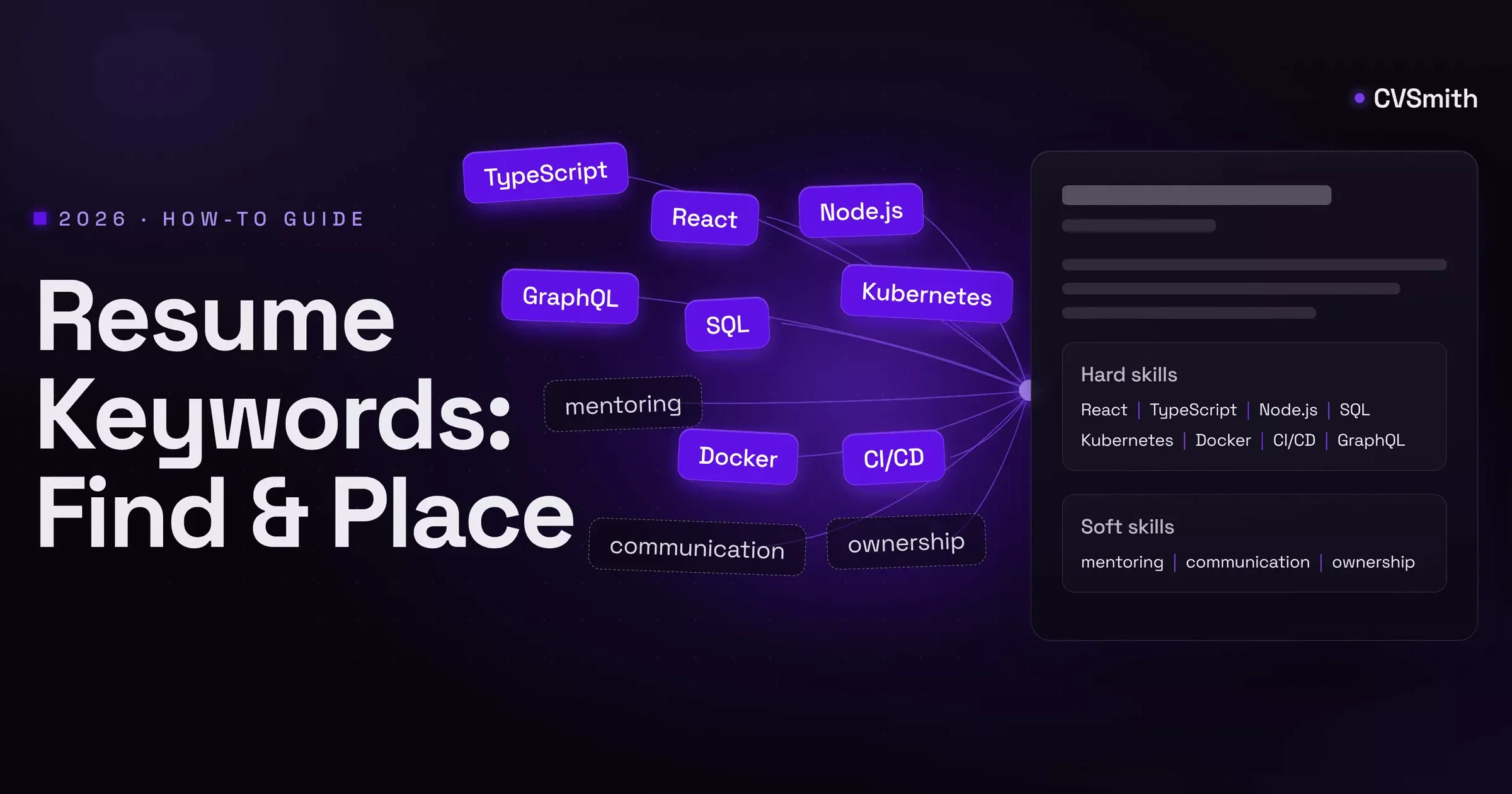
A recruiter opens the applicant tracking system, types four words from the posting into the search bar, and reads whatever comes back. Resume keywords are those four words and the thirty others like them. This guide shows you which words those are, how to pull them out of a job description in one pass, which ones to leave out, and where to put them so they read as proof instead of a list.
What resume keywords actually are
Keywords are the nouns a posting uses for things it can verify: skills, tools, certifications, methods, and role titles. Not adjectives, not values, not the culture paragraph. You will also see them called ATS keywords for resume: the same words, named after the applicant tracking system that searches for them.
Five kinds show up in almost every posting:
- Hard skills. The work itself: data modeling, contract negotiation, A/B testing, incident response.
- Tools and technologies. Named products: Salesforce, Figma, Kubernetes, SAP, QuickBooks.
- Certifications and licenses. PMP, CPA, AWS Solutions Architect, RN, SHRM-CP.
- Role titles and seniority. The exact title in the posting, plus the level: senior, lead, manager, II.
- Domain and method terms. Agile, HIPAA, GAAP, B2B SaaS, clinical trials, demand generation.
One test tells them apart from noise: a keyword is something a bullet on your resume could prove with a number, a scope, or an outcome. "Led SOX audits for three business units" proves SOX. "Passionate self-starter" proves nothing, so it is not a keyword no matter how often it appears.
60 resume keywords by category
A reference list, not a shopping list. Use a term only where the posting names it and your experience backs it.
| Category | Examples |
|---|---|
| Engineering and data | Python, SQL, TypeScript, React, Kubernetes, Docker, CI/CD, REST APIs, data pipelines, ETL, unit testing, observability, machine learning |
| Product and design | roadmap, user research, A/B testing, Figma, Jira, wireframing, usability testing, design systems, OKRs, product analytics, stakeholder management, go-to-market |
| Marketing and sales | SEO, paid search, Google Analytics 4, HubSpot, Salesforce, pipeline generation, lifecycle email, content strategy, CAC, ROAS, account management, quota attainment |
| Finance and operations | GAAP, financial modeling, variance analysis, forecasting, budgeting, SAP, NetSuite, procurement, supply chain, Lean, Six Sigma, P&L ownership |
| People, healthcare, and admin | ATS administration, onboarding, HRIS, Workday, payroll, EHR, patient care, HIPAA, scheduling, vendor management, compliance |
Two things the table cannot tell you: which of these a given posting requires, and which it only prefers. That is the job of the next section.
How to find keywords in a job description
Read the posting once with a highlighter, in this order.
- Start with the requirements block. Lines under "Requirements", "Qualifications", "What you'll need", or "Must have" are the required keywords. Everything named there goes on the list first.
- Mark the repeats. A term that appears in the title, the first paragraph, and the requirements is the posting's center of gravity. Repeated terms outrank single mentions even when both sit in the requirements.
- Read the title and the first paragraph separately. They carry the role title and the one or two capabilities the hiring manager cares about most. Those words belong in your summary.
- Split "preferred" from "required". "Nice to have", "bonus", "ideally", and "a plus" mark the preferred list. Cover every required term you can honestly claim before spending a line on a preferred one.
- Check two more postings for the same role. Open two similar postings from other companies. Terms that show up in all three are the vocabulary of the role, not one recruiter's habit, and they are the safest bets for your skills block.
By hand this takes about half an hour per posting, most of it spent on step 5. That is fine for three applications a week. It stops being fine at fifteen, which is why a finder exists further down this page.
Which words to ignore
Skipping the wrong words is half the work. Leave these out:
- Culture language. "Fast-paced", "collaborative", "mission-driven", "wear many hats". Nobody searches the ATS for them.
- Generic soft skills. "Team player", "strong communicator", "detail-oriented". If the posting names one as a hard requirement, show it inside a bullet with a result; never list it.
- Boilerplate. Equal-opportunity statements, benefits, "about us" paragraphs, and the "other duties as assigned" line.
- Verbs dressed as skills. "Drive", "own", "spearhead". Action verbs open a bullet; they are not keywords.
- Terms you cannot back. A keyword you have never used gets you an interview question you cannot answer. Leave it off and let the resume be honest about the gap.
Where to put keywords in a resume
Placement decides whether a parser and a recruiter both credit the term. Four spots, in the order they are read:
- Title line. Use the posting's title, or the closest true version of it, under your name. "Senior Product Manager" beats "Product leader and builder".
- Summary. Two or three lines that carry the role title and the three capabilities from the posting's first paragraph. This is the text a recruiter reads before deciding to scroll.
- Skills block. A short, grouped list of hard skills and tools in the posting's spelling. Ten to fifteen terms, grouped by type, no soft skills.
- Experience bullets. The keyword plus an action and an outcome: "Migrated 40 services to Kubernetes, cutting deploy time from 25 minutes to 4." One bullet like that outweighs the same term listed three times.
The bullet is the placement that matters most. A parser counts the term either way, but a recruiter reading "Kubernetes" in a skills list learns nothing, and reading it in a bullet with a number learns you did the work. Aim for every required keyword to appear once as a plain term and once inside a bullet with evidence.
Why keyword stuffing fails
Stuffing is any attempt to raise the count without adding proof: a skills block with forty entries, the same term repeated in every bullet, or a paragraph of keywords pasted at the bottom in white text.
- Parsers dedupe. Most modern systems count a term once per document. The tenth repeat adds nothing to the score.
- Recruiters read. The first human to open the file sees a resume that reads like a search query and moves on. Match scores get you into the pile; the text gets you out of it.
- Hidden text gets flagged. White-on-white keywords and one-point fonts are visible to every parser and to any recruiter who selects all. Several systems mark them as manipulation.
- Interviews test the list. Every keyword on the page is a question you may be asked. A stuffed resume books interviews you cannot pass.
The fix is placement, not volume: fewer terms, each one in the posting's spelling, each one backed by a bullet. If you want a second opinion on how the big checkers grade this, the ATS checker comparison walks through what each tool actually scores.
Find the keywords in a job description in seconds
Everything above is the manual method, and it works. It also takes thirty to forty minutes per application once you count the second and third postings. Paste the posting or its link below and the finder does the read for you: the terms it asks for, split into required and preferred, with a marker on each for hard skills versus traits.
Find the keywords in a job description
Paste the posting or its link. You get the skills, tools, and phrasing it asks for, split into required and preferred.
We read the posting for you. Behind a login? Switch to Paste JD.
No account needed · 3 free lookups a day
The list is step one. To see which of those terms your resume already covers and which required ones it is missing, run the resume keyword scanner with your file, or match your resume to the job description for a bullet-level read. The finder also lives on its own page at job description keyword finder if you want to bookmark it.
If you would rather not repeat this for every application, that is what CVSmith does (full disclosure: it is ours). Save a job and it pulls the keywords, checks your resume against them, tailors the bullets around the required terms, and tracks the application from saved to offer. Free to start, then $9/month.
FAQ
- How many keywords should a resume have?
- Every required term from the posting you can back with real experience, usually ten to fifteen, placed in the summary, the skills block, or a bullet with an outcome. Forty stuffed terms score worse than twelve placed ones: parsers dedupe repeats and recruiters skip lists that read as spam.
- Should I copy the exact phrasing from the job description?
- Yes, for the term itself. Write "Google Analytics 4" if the posting says that, not "GA". Recruiters search the ATS by the words they typed into the posting, and many parsers match exact strings before they try synonyms. Do not copy whole sentences; the words go into your own bullets.
- Do synonyms count as resume keywords?
- Sometimes. Modern parsers map common variants such as JS and JavaScript, but the safe move is the posting's spelling once, with the variant next to it if you use it: "Kubernetes (k8s)". Certifications and tools rarely get synonym credit, so spell those exactly.
- Do applicant tracking systems look for keywords?
- Yes. Recruiters run keyword searches inside the ATS, and match scores are built on the overlap between the posting and your resume. The parser reads the words, the recruiter reads the proof, so a keyword only counts where a bullet backs it.
- What are keywords in a CV, and does the UK need a different approach?
- The same thing: the skills, tools, certifications and role titles the posting names. UK CVs follow identical rules. Use the employer's spelling, including British variants, and put the terms in the profile line, the key-skills block, and the experience bullets.
- Where do resume keywords matter most?
- The title line and summary are read first by humans and weighted first by many parsers, then the skills block, then the bullets. A required keyword should appear in at least two of those places, once as a plain term and once inside a bullet with an outcome.
- What about soft skills like communication or leadership?
- Include them only when the posting names them as requirements, and show them in a bullet rather than a list: "presented the roadmap to 40 stakeholders each quarter" carries communication without the word. Soft skills in a skills block read as filler.
- How do I check which keywords my resume already has?
- Run the resume keyword scanner with your file and the posting. It lists the terms you cover, the required ones you are missing, and where to add them. It is the same check the finder above starts with, plus your resume.
The short version
Keywords are the verifiable nouns in a posting: skills, tools, certifications, titles, methods. Pull them from the requirements block first, weight the repeats, split preferred from required, and check two more postings for the same role. Skip culture language and soft-skill adjectives. Put each required term in the title line or summary, in a grouped skills block, and in one bullet with an outcome. Never stuff. Run the finder above when the posting count climbs, and check the resume against the list before you send it.